Every week, we get questions about playlists.
How do I get on one? How do I get on a bigger one? Why did another artist get added and I did not?
The attention playlists receive can sometimes be bigger than their actual impact.
That does not mean playlists are unimportant. A significant part of our work at Syntax involves pitching music for them. But a playlist placement works best as one piece of a larger strategy, not the entire strategy.
We wanted to see what the numbers actually showed.
The case studies below use real Syntax Creative release data collected around 2023 and early 2024. We changed the artist, song, playlist and platform names, but the performance data is real. Each digital service provider (DSP), meaning a streaming or download service that makes music available to listeners, behaves differently.
That difference turns out to be pretty important.
Case study 1: Position on the playlist matters
Artist A and Artist B released music on the same day in similar genres.
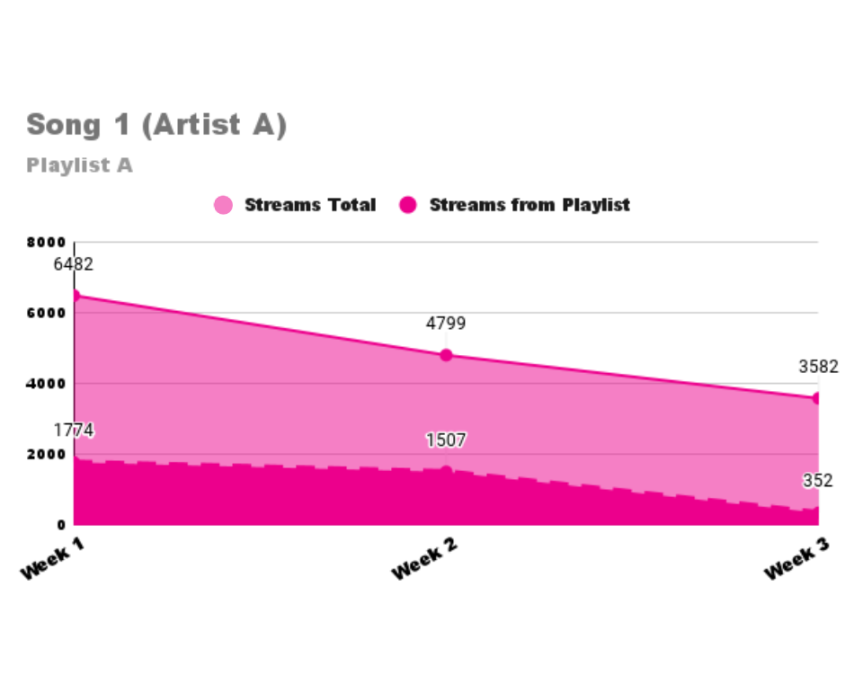
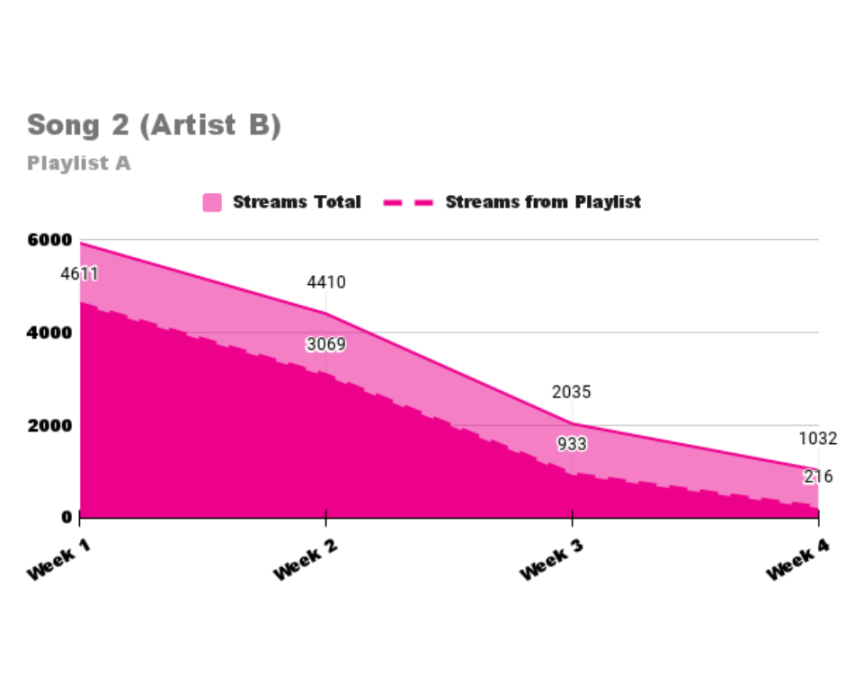
Artist A was established and entered the campaign with more than 184,000 monthly listeners. Artist B was a new duo with about 3,150 monthly listeners.
Both landed on Playlist A, but Artist B entered at No. 3 while Artist A appeared at No. 31.
The playlist rotated new music fairly quickly. Artist A remained for three weeks, while Artist B stayed for four.
For Artist A, only 27% of first-week streams came from the playlist. The artist already had a sizable audience generating streams elsewhere.
Artist B was a different story. The higher position generated substantially more playlist activity even though the duo began with a much smaller audience.
The takeaway is simple: getting on a playlist and getting a strong position on that playlist are not the same thing.
Case study 2: Some playlists barely move the total
Next, we looked at the same two artists on another DSP.
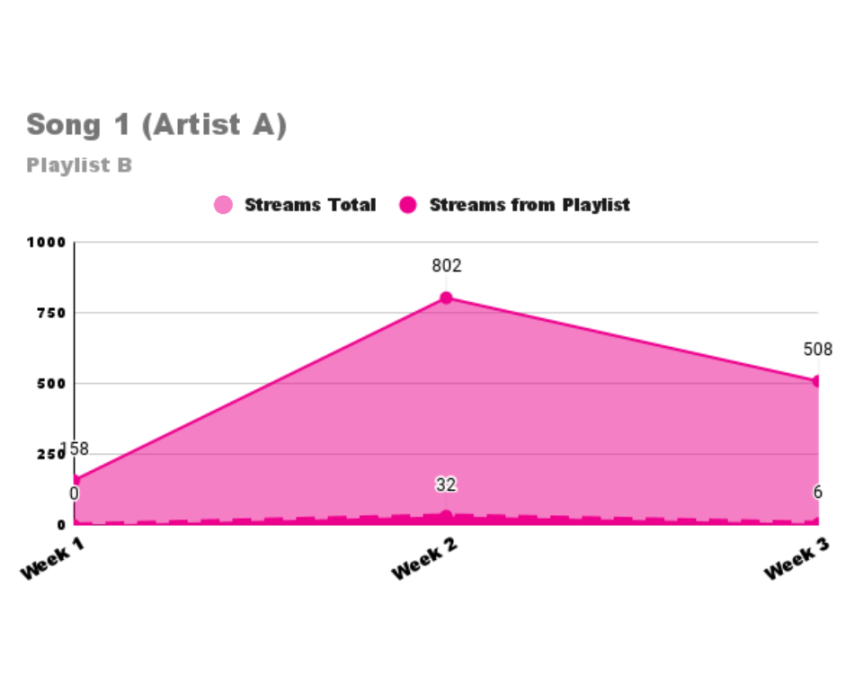
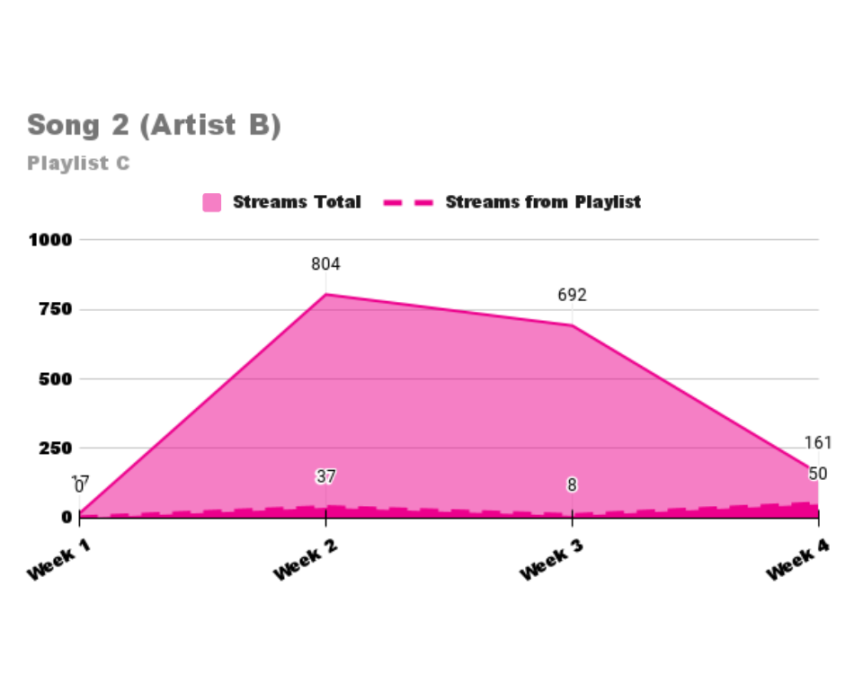
Artist A received the No. 14 position on Playlist B. Artist B landed at No. 2 on Playlist C.
Again, both playlists focused on newer music and rotated songs out after a few weeks.
Despite those placements, neither artist received any playlist streams during the first week in the data we studied.
Even in later weeks, playlist activity remained a small part of their overall listening on this service. In the releases we analyzed, playlist placements generally contributed less than 5% of total streams there.
Other discovery features, particularly stations and recommendations, played a much larger role.
That is an important reminder. A DSP may have playlists, radio, personalized recommendations and other discovery tools working at the same time. The feature with the most visible name is not necessarily the one generating the most listening.
Case study 3: The right playlist can completely change a song
The third DSP behaved very differently.
Here, playlist placements can sometimes last for months or even years.
We have seen tracks accumulate hundreds of thousands of streams from a single long-running playlist placement. And importantly, those placements do not always happen on release day.
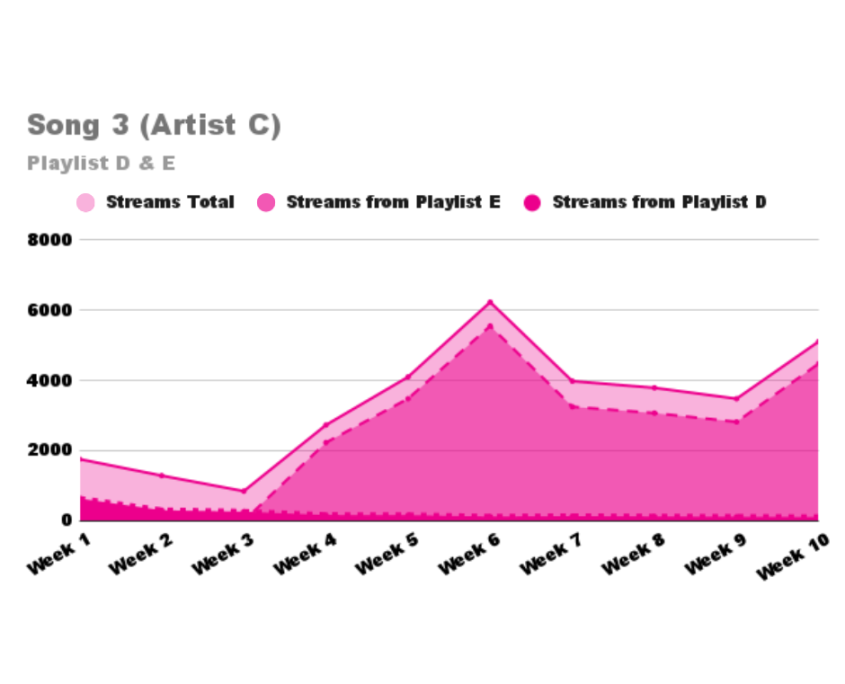
Artist C provides a good example.
During the first three weeks, roughly 70% of the song’s streams came from places other than Playlist D.
Then another playlist added the track.
Overall streams jumped by nearly 300%, and about 85% of the streams during that initial jump came from the new playlist. The placement remained active for 22 weeks.
Artist D shows an even more dramatic example.
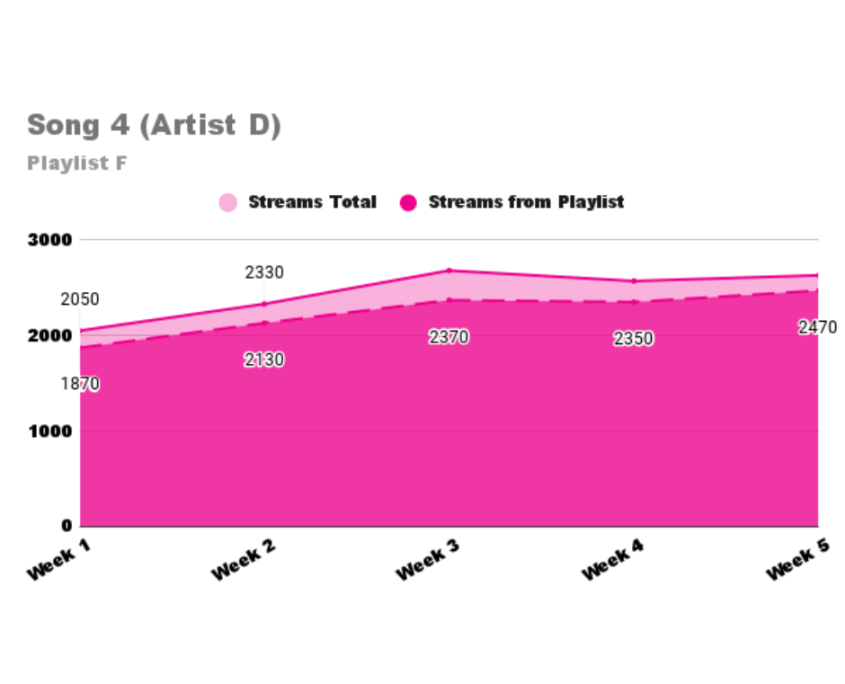
This was a debut single in a small niche. On release day, the song landed on Playlist F.
More than 90% of its early streams came from that playlist. Twenty weeks later, the placement was still responsible for roughly 70% of the song’s streams.
So yes, a playlist absolutely can change the trajectory of a release.
It just does not happen every time.
Case study 4: Playlist discovery can lead somewhere else
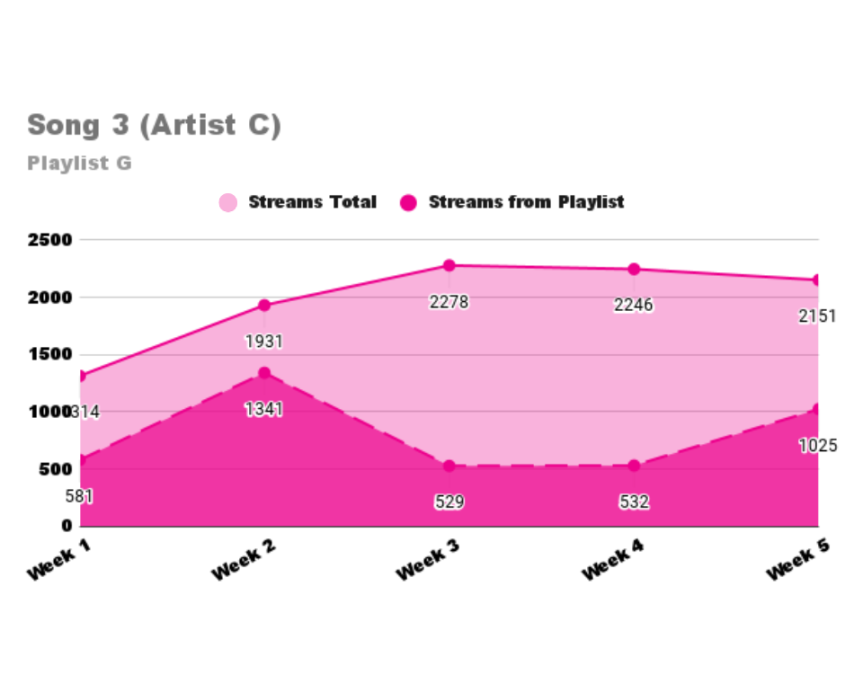
Artist C also received the No. 1 position on Playlist G at another DSP.
During the year we studied, the track generated nearly 100,000 streams on that service, with almost 30,000 coming directly from the playlist placement.
But the more interesting part happened later.
During weeks three and four, playlist streams dropped sharply while total streams continued to rise. Much of the remaining activity came through stations.
That is exactly what you want to see.
The playlist introduced people to the song, but listening did not depend entirely on staying inside that playlist.
Discovery had started creating activity elsewhere.
Case study 5: What happens after the playlist matters more
Streams are only part of the story.
Artists also pay close attention to monthly listeners, the number of unique Spotify listeners who heard an artist during the previous 28 days.
A playlist can increase that number quickly.
Keeping those listeners is harder.
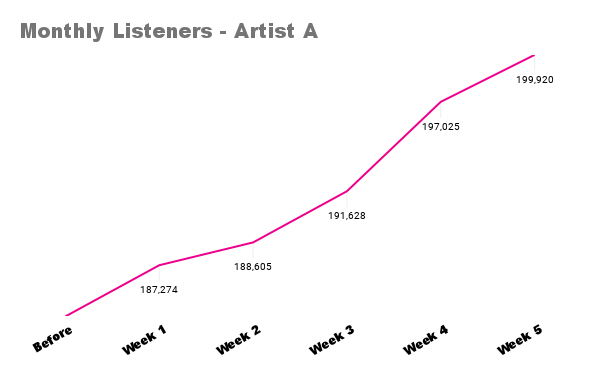
Artist A
Artist A continued gaining monthly listeners even after the playlist placement ended.
Two things were happening at once.
The placement reintroduced an established artist to listeners who may have fallen away. At the same time, the artist was releasing a sequence of singles leading into an album.
So instead of one playlist spike happening in isolation, listeners had more new music waiting for them.
Artist B
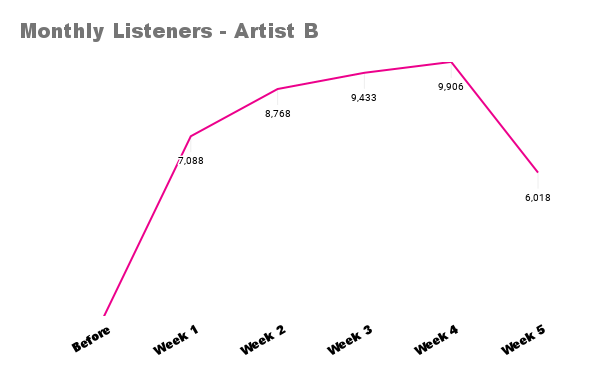
Artist B had grown from zero to about 3,000 monthly listeners during a three-single rollout before this case study began.
The strong playlist placement then pushed monthly listeners to nearly 10,000.
Once the placement ended, that number fell to just over 6,000.
That was still meaningful growth, but roughly half of the listeners gained during the peak did not remain.
Artist C
Artist C had another advantage: a larger campaign surrounding the release.
The band had playlist placements, radio activity, additional singles and an album rollout working together.
Monthly listeners grew from roughly 46,000 before the campaign to more than 55,000 at the peak. Even after some decline, the artist remained well above the starting point.
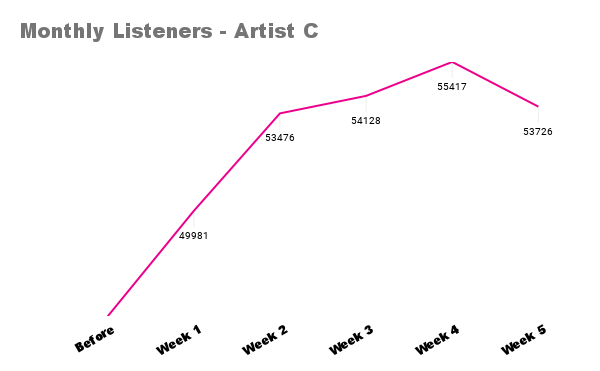
That is the bigger lesson.
The playlist helped, but it was not working alone.
A playlist placement is an opportunity, not a strategy
These case studies produced very different outcomes.
One playlist accounted for almost none of an artist’s streams. Another generated the overwhelming majority. A placement helped one artist retain new listeners, while another lost a large portion of the audience once the placement ended.
Platform matters. Playlist size matters. Position matters. Artist development matters. What else is happening around the release matters.
So celebrate a good playlist add.
Then keep working.
Give newly discovered listeners another song to hear. Build the artist profile. Keep releasing good music. Create content. Work radio, publicity, live opportunities and the other parts of the campaign that make sense.
If the playlist does not happen at all, our guide to what to do when you don’t get playlisted covers plenty of ways to keep moving.
You can also become part of music discovery yourself by creating and curating your own playlist.
The goal is not getting playlisted
The goal is building an audience.
A playlist can help accomplish that. Sometimes it helps a little. Sometimes it helps a lot.
But if all the growth disappears the moment the placement ends, you rented attention for a few weeks.
The better outcome is when somebody discovers the song through a playlist, explores the catalog, follows the artist and comes back for the next release.
That is when a playlist becomes more than a stream count.